
Manish Choudhary
CEO & Co-founder, Flexprice

I remember our first enterprise contract at Flexprice. The procurement was a different animal, but the real shock came after: every enterprise customer we onboarded ran its own contracts with its own customers, and our enterprise billing system had to model all of them.
No two shared the same terms. One ran a 14-month term, another phased its commitment across three stages, a third wanted quarterly invoices on an annual contract. That's the job: absorbing complexity you can't predict, and the list only grows as you close more deals. Here's what breaks when your first big contracts land.
Key Takeaways
Enterprise buyers security-review your billing stack before they pay you. Data residency, access control, and audit trails are billing requirements now, and a vendor that can't answer them kills a deal sales already won.
Running enterprise deals on spreadsheets next to self-serve billing is where revenue leakage starts. MGI Research puts leakage at 3 to 5% of revenue minimum, and past SEC materiality it becomes an accounting violation.
Billing doesn't break at an ARR milestone. It breaks the moment deals stop being uniform: the first custom price, the first ramp, the first mid-cycle amendment.
TestZeus, Simplismart, Segwise, and CASParser all fixed this by moving onto contract-native billing infrastructure, in days rather than quarters, and the numbers followed.
An enterprise billing system is a procurement asset as much as a finance tool: SOC 2 Type II, on-premise deployment, RBAC, and contract versioning are what the buyer's review is checking for.
Why the buyer's security review reaches your billing stack
The buyer's security review reaches your billing stack because usage data is customer data, and procurement audits every system that touches it. The first enterprise deal you close will audit you before it pays you.
Enterprise procurement runs on security questionnaires, and these aren't vibes-based checklists. The CAIQ, the standard questionnaire from the Cloud Security Alliance, contains 261 questions across 17 control families. The SIG questionnaire from Shared Assessments covers 21 risk areas. Buyers send these before contracts sign, and answering them lands on whoever built the systems, which usually means you.
Practitioners describe this stage with a specific kind of exhaustion. One founder on Hacker News listed his enterprise-sales pains in January 2025, including "having to fill endless security questionnaire without being sure you can even sell to them", and described working through 100-plus questions late at night with no guaranteed deal at the end.

From the buyer's side, a platform engineer at a large company described a 1 to 2 month procurement process even when he already wanted the product.
The burden is structural, and it's growing every single day.
Vanta surveyed 3,500 business and IT leaders in 2025 and found 61% now spend more time proving trust than actually protecting their business.
And here’s the saucy part, those questionnaires reach your billing stack. Usage data is customer data, so the review asks where it lives, which is a data residency question.
It asks who on your team can change prices and edit invoices, which is a question about RBAC, or role-based access control, defined permissions for who can view or modify what.
It asks whether contract changes leave a trail, which is a question about versioning.
Your billing vendor's answers become your answers, and I've watched sales teams learn this the hard way. You have to win that enterprise deal twice, once against your competitors, once against a spreadsheet with 261 rows.
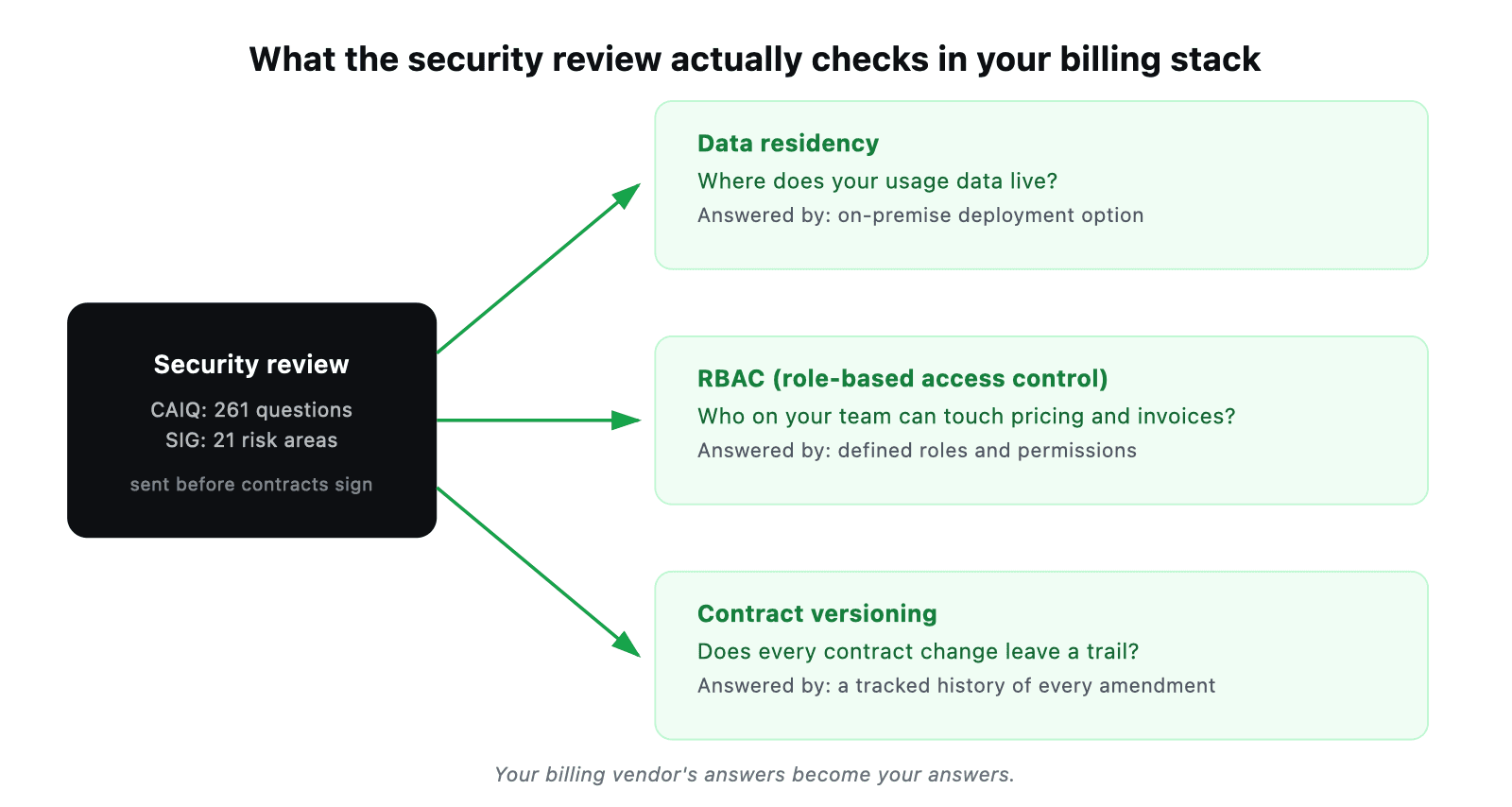
This is what a passing posture looks like in practice. Flexprice ships SOC 2 Type II, an on-premise deployment option for data-residency demands, RBAC over pricing and invoices, and contract versioning that gives every amendment a history.
One of our customers put the requirement bluntly: "We weren't willing to give up control of our data, but we still needed a reliable subscription tool. Flexprice on-prem was the only thing that worked for us." - Martin Sønderkær Jung, CTO, CB.DK
Manish, our CEO, sits on the vendor side of these reviews: "Enterprise security reviews don't stop at your product. Buyers ask where usage data lives, who on your team can touch pricing and invoices, and whether every contract change leaves a trail. We've seen deals where the on-prem option was the answer to the one question procurement wouldn't move on." - Manish Choudhary, CEO, Flexprice
Passing review gets you the contract. Then your billing system has to run it, and most teams quietly run it somewhere else.Why running enterprise deals on a separate system leaks revenue
Why running enterprise deals on a separate system leaks revenue
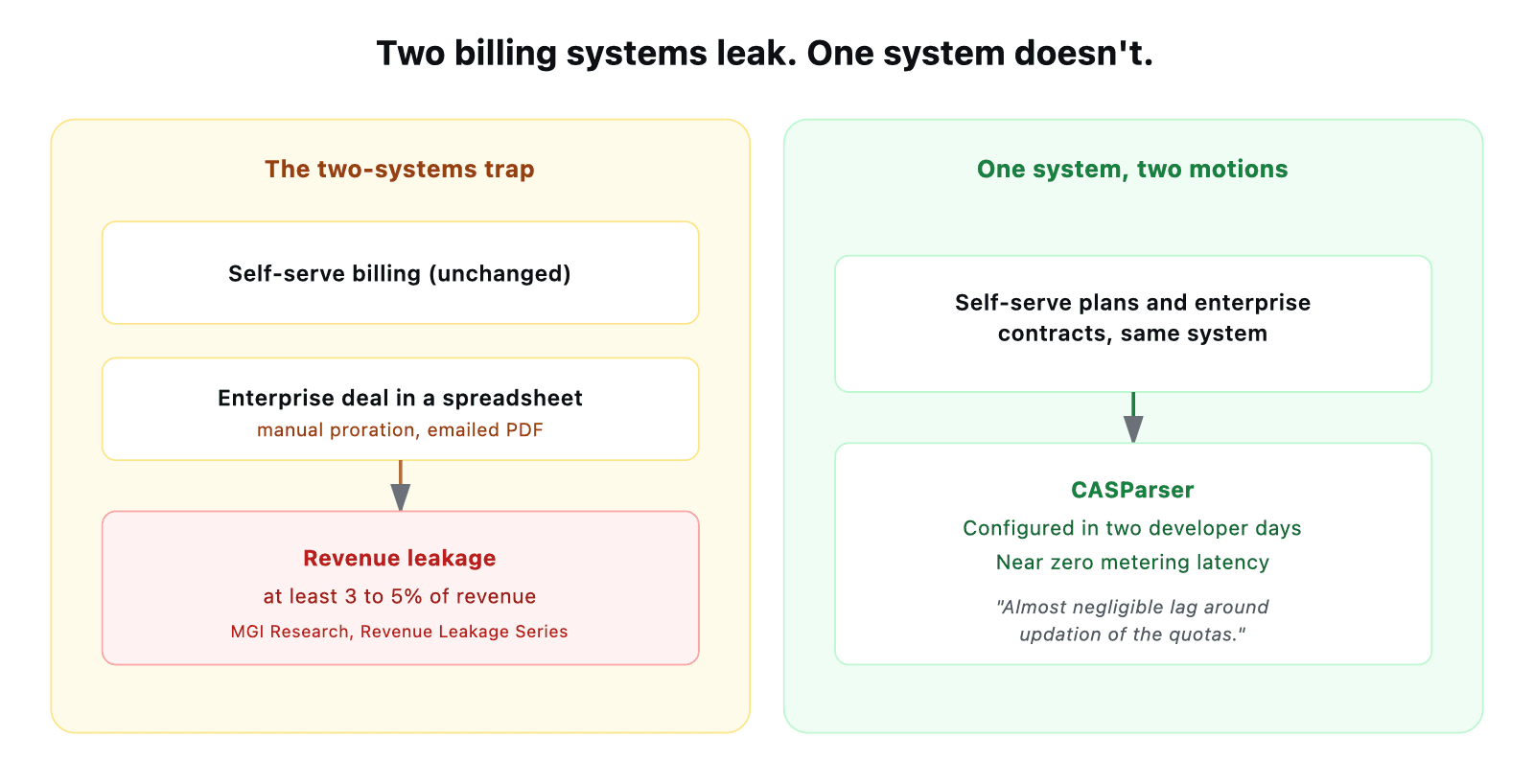
Self-serve keeps running on the existing setup. The enterprise deal lives in a spreadsheet, where someone in finance builds the invoice by hand, calculates proration manually (proration means charging a partial amount when a change lands mid-cycle, like adding 50 seats three weeks into the month), and emails a PDF.
No enterprise invoicing software in the loop, just a spreadsheet and goodwill. Everyone calls it temporary and here’s a secret, it never is temporary.
I get why it happens. The deal closed, you see the revenue, and enterprise billing automation feels like a next-quarter problem.
We’ve seen our customers go through the same ordeal more than we would like to admit, and due to this the invoices that should have been paid on 1st week of let’s March used to get delayed till 20th of June.
And there were some which never even made the list. Hence revenue leakage!
But the parallel process is exactly where revenue starts leaking. MGI Research, which has published a five-part series on the problem, defines revenue leakage as the variance between contractually obligated revenue and actual recognized revenue.
And finds it represents at least 3 to 5% of every company's revenue. Past SEC materiality thresholds (5% of revenue, 10% of EBITDA), leakage becomes an ASC 606 violation, the accounting standard governing revenue recognition, and triggers SOX 404 remediation, the compliance regime that makes public-company auditors very unhappy.
MGI's conclusion cuts deep the leaking company "doesn't have a pricing problem", it has "a revenue capture problem."
The trap is also becoming the default. As of late 2025, 47% of companies that raised funding in the prior 12 months identify as PLG-focused, per a 2025 GTM benchmark analysis drawing on the Kyle Poyar and Maja Voje survey of 195 software companies. Nearly half the market runs a self-serve motion, and the moment those companies close enterprise deals, they're running both motions on infrastructure built for one.
One system can carry both. CASParser runs sales-led enterprise contracts and product-led self-serve on a single Flexprice setup, configured end to end in two developer days, with near zero metering latency. Their founder's review of the result: "It just magically works behind the scenes. There's almost negligible lag around updation of the quotas." - Sameer Kumar, Founder, CASParser
The trap exists because of what enterprise deals actually contain. Underneath the spreadsheet is a structural mismatch.
Why enterprise deals break plan-based billing systems
Your current billing set up starts to give up when deals stop being uniform, and enterprise deals are never uniform.
As Navin Persaud, VP of Revenue Operations at 1Password, put it in our conversation on enterprise billing infrastructure, the breaking point isn't revenue; it's the moment you're hiring operators whose entire job is managing billing exceptions a well-configured system would handle automatically.
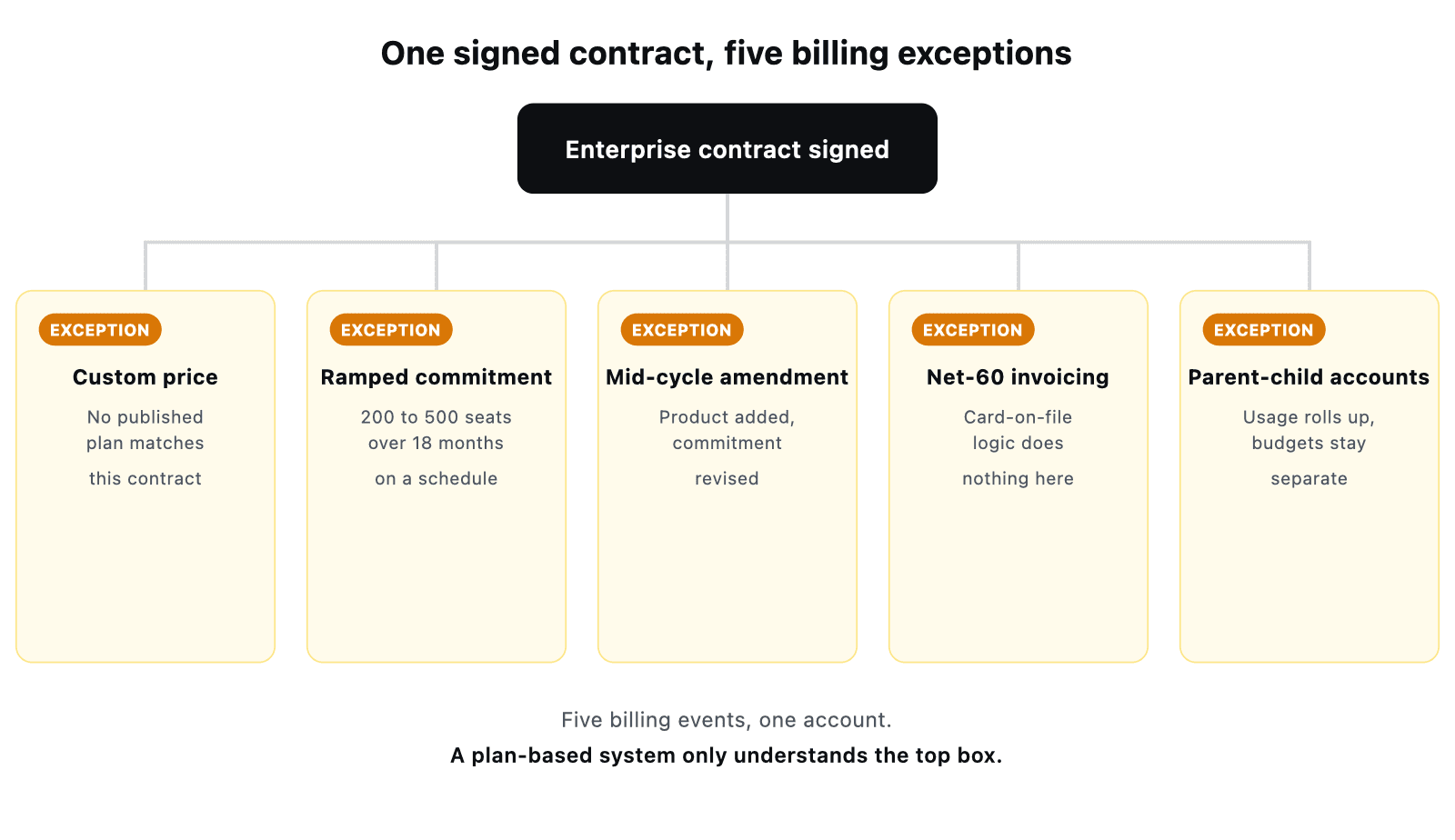
Watch what one signed contract does to a plan-based system. The customer negotiated a custom price, so their subscription no longer matches any published plan. They committed to a ramp (a ramped contract steps the commitment up over time, say 200 seats now and 500 by month 18), so the price changes on a schedule your system doesn't know about.
Six months in, they add a product, which is a mid-cycle contract amendment requiring proration and a revised commitment. They pay by invoice on net-60, so card-on-file logic does nothing.
And their subsidiaries need consolidated invoicing under a parent account, a parent-child structure where usage rolls up but budgets stay separate. Five billing events, one account, and every one is an exception in a system that only understands plans.
Legacy billing systems assume pricing changes are rare. Enterprise contracts amend constantly, and every amendment your system can't model becomes engineering work that queues behind the product roadmap.
Simplismart lost 20 to 30% of a developer's daily bandwidth to exactly this kind of maintenance.
There's a reason the 2022 Hacker News thread titled "billing systems are a nightmare for engineers" collected 777 points and 359 comments; my favorite reply in it argues the nightmare was never the engineering, it's the specification.
A negotiated contract is precisely that: a specification that changed after the system shipped.
TestZeus hit this wall with a fixed number of SKUs hard-coded in a microservice, manual usage tracking, and every pricing change routed through engineering.
After moving to Flexprice, their GTM team configured 15 enterprise trials with zero engineering involvement. The integration went live in 3 days with 1 engineer, and they estimate roughly a month of engineering time saved.
Teams that hit this wall either build around it or route through it. The outcomes differ, and we have names for both.
How two companies fixed broken enterprise billing
Billing failure stories usually stay anonymous, so here are two companies that lived the whole arc, with numbers.
Simplismart spent 1.5 to 2 months building a custom billing engine on top of one of our competitor’s open source core.
Maintaining it consumed 20 to 30% of a developer's day, and it broke under heavy load. After switching to Flexprice, they reclaimed 30% of daily engineering bandwidth, saved $145K+ annually, iterated on pricing 6x faster, and scaled to 750+ pricing features.
Their head of engineering doesn't hedge "If billing doesn't work, we don't make money. Flexprice lets us focus on the core business instead of building billing as a second product." - Shubhendu Shishir, Head of Engineering, Simplismart
Segwise took the other path to the same wall. They spent 3 weeks trying to build credit-based pricing in-house, then shipped it with Flexprice in 3 days. They now track 100+ enterprise customers with zero manual intervention.
I have mixed feelings about the build-it-yourself instinct, honestly. It's the rational-feeling choice, engineers are good at building systems, and it ages worse than almost any other technical decision I've seen.
Both companies above made the fix in days once they stopped treating billing as a product they had to own. The pattern across both stories is the same they stopped building billing and moved it onto infrastructure that already speaks contracts.
Both stories converge on a capability list, and that list is the real definition of the category.
What does an enterprise billing system have to handle?
An enterprise billing system has to run every failure mode above as a configuration, without engineering. Each capability below maps to a failure from this article; use it as the test list when you evaluate any enterprise billing solution:
Per-customer price overrides and custom minimums that don't fork your plan catalog, so one negotiated deal doesn't spawn a shadow SKU (Pricing Models)
Usage, subscription, and one-time fees on a single invoice, with credits and proration applied automatically and a preview before anything finalizes (Billing and Invoicing)
Plan migrations, grandfathering for legacy customers, and a tracked history of every pricing change for the audit trail procurement asked about (Pricing Experiments)
Ramped contracts that step commitments up on schedule, and parent-child accounts that consolidate subsidiaries onto one invoice
The posture layer: SOC 2 Type II, on-premise deployment, RBAC, and a 99.99%+ uptime SLA, because enterprise billing software is itself a vendor your buyer reviews
That's the checklist version of everything this article argued, and our enterprise billing guide covers the category end to end if you want the full map.
If you're translating your own contracts into implementation, the Flexprice docs walk through overrides, ramped contracts, and entitlements.
The next enterprise deal is the test, and it grades your billing before it pays you. My immediate suggestion is to pull your last three custom deals and map each negotiated term against the list above.
Anything your current setup handles in a spreadsheet is a gap, and the time to close it is before procurement asks, since an enterprise billing system takes days to adopt but a stalled security review can cost you a quarter.
If the gaps look structural rather than cosmetic, book a demo and we'll walk through your contracts together.
What is an enterprise billing system?
How is enterprise billing different from standard SaaS billing?
When should a company switch to an enterprise billing system?
Can one billing system run self-serve plans and enterprise contracts together?
What compliance and security requirements should an enterprise billing system meet?